
Chandra Reveals How a Galaxy-Cluster Collision May Have Revived a Strange Radio Structure
Chandra, eROSITA and radio observations suggest the 'Treble Clef' is a radio phoenix: old black-hole plasma apparently reenergized during a galaxy-cluster merger. The proposed sequence remains a scientific interpretation.
The story in plain English
Chandra, eROSITA and radio observations suggest the 'Treble Clef' is a radio phoenix: old black-hole plasma apparently reenergized during a galaxy-cluster merger. The proposed sequence remains a scientific interpretation.
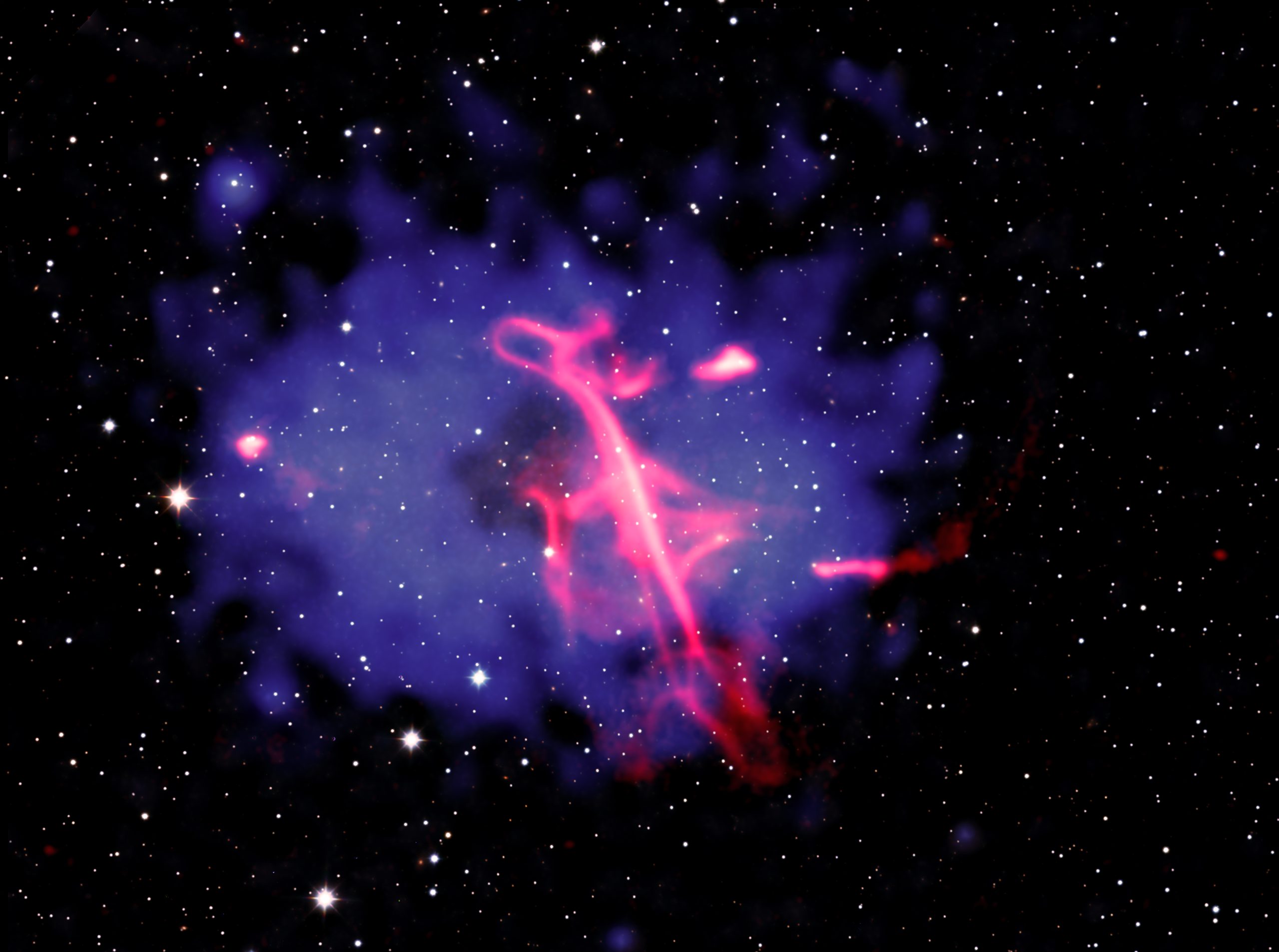
Behind a dense foreground of Milky Way stars and dust, astronomers have identified a likely explanation for an unusually shaped radio source nicknamed the Treble Clef. A study reported by NASA on October 14, 2026, combines X-ray and radio observations to investigate how the structure formed inside a merging pair of galaxy clusters.
A radio shape hidden behind the Milky Way
The object, cataloged as VLSS J0318.9+5755, sits near the plane of our galaxy, where foreground material complicates observations. Researchers used X-ray data from NASA’s Chandra X-ray Observatory and the eROSITA telescope to characterize the hot gas around the radio structure. Observations from the LOFAR radio telescope network and additional radio measurements reveal bright, filamentary emission that resembles a musical symbol.
The resemblance is a human visual association, not a literal symbol in space. The released color image is a scientific multiwavelength composite, not an ordinary visible-light photograph: X-rays and radio emission are assigned display colors to reveal structures our eyes cannot directly see.
What the observations suggest
The researchers favor a two-stage explanation. An earlier episode of activity from a supermassive black hole may have ejected clouds of energetic particles and magnetic fields, producing radio emission that gradually faded. Later, the interaction of two galaxy clusters may have compressed or reenergized that older plasma, making it bright at low radio frequencies again. Astronomers call such revived material a radio phoenix.
Evidence of a cluster merger appears in the X-ray gas distribution. The authors analyzed deviations from a smoother, approximately elliptical hot-gas profile, identifying asymmetries consistent with a collision. Their interpretation is supported by several types of observations, but the exact history and geometry remain a model, not a direct recording of events hundreds of millions of years ago.
Why this matters
The findings show how galaxy-cluster mergers can change old material deposited by active black holes. They also demonstrate the value of combining different observatories when visible light is obscured. Further low-frequency radio observations may clarify how the filaments were shaped and how long the particles have been aging.
Sources and image policy
NASA science report: Chandra explains the Treble Clef, October 14, 2026. Original research: Botteon et al., The Treble Clef radio phoenix and its old nonthermal filaments, revised October 5, 2026. Featured image is the actual 2026 scientific composite published by NASA. This is a multiwavelength visualization of telescope data, not a visible-light photograph or an AI-generated illustration. Credit: X-ray, NASA/CXC/INAF-IRA/A. Botteon et al.; infrared, UKIDSS-GPS; radio, ASTRON/LOFAR; image processing, NASA/CXC/SAO/N. Wolk. NASA image and credits.
Primary source: NASA Chandra X-ray Observatory ↗
Research paper: Open paper ↗
Start the conversation