
Webb Maps Star Birth in N159, a Nebula 161,000 Light-Years Away
Webb's infrared view of N159 reveals young stars in dense gas clouds. Here's what the observations show, and what remains an interpretation.
The story in plain English
Webb's infrared view of N159 reveals young stars in dense gas clouds. Here's what the observations show, and what remains an interpretation.
This story discusses preliminary research. Findings may change as the work is reviewed, replicated, or updated.
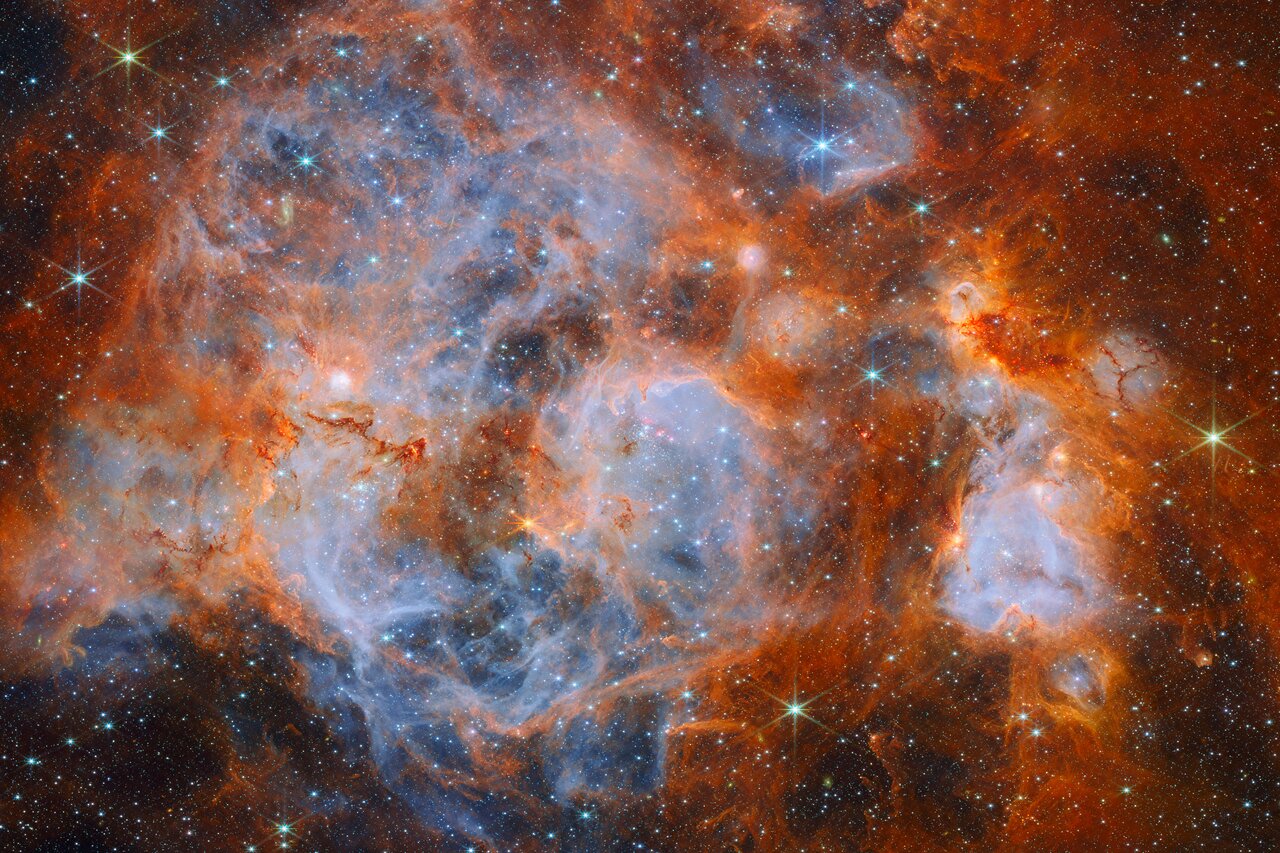
ESA/Webb released a new James Webb Space Telescope view of N159 on October 22, 2026. It reveals stars at different stages of formation within the same sprawling cloud. The region lies about 161,000 light-years away in the Large Magellanic Cloud, a small galaxy neighboring the Milky Way. The published image spans roughly 230 light-years, a reminder that the bright knots and dark ridges in the picture are enormous structures, not individual clouds the size of our solar system.
What Webb actually observed
Webb’s Near-Infrared Camera recorded light passing through and emerging from N159’s gas and dust. The scene contains bright regions of ionized hydrogen, dense molecular filaments and young stars still embedded in their birth clouds. Powerful ultraviolet radiation from hot stars changes the surrounding hydrogen gas, while stellar winds reshape the cloud into cavities and ridges.
The orange, blue and red areas in ESA’s processed image help separate different types of emission, including carbon-bearing molecules and molecular hydrogen. These are assigned display colors based on infrared measurements, not the colors a person would see by looking through a window in space. The photograph is a genuine telescope observation, not an artist’s rendering.
Why the western side matters
The team analyzed more than 300,000 detected light sources in ten Webb near-infrared filters. Its study reports stars with estimated masses below one-tenth of the Sun’s mass and evidence that the western part of N159 contains a stronger concentration of very young star candidates than the eastern part. That pattern supports a picture of star formation unfolding in stages across the nebula, rather than all its stars being born at once.
This is a scientific interpretation of measured light, not a direct movie of stars forming. Researchers identify young-star candidates through their infrared colors and other indicators, which can carry classification uncertainties. The research was available as a September 22 preprint when ESA released the image; readers should not confuse that preprint with a separately verified peer-reviewed publication.
Why astronomers study N159
The Large Magellanic Cloud has a lower abundance of elements heavier than hydrogen and helium than our galaxy. That makes N159 a useful nearby laboratory for testing how stars form under conditions that differ from the Milky Way and resemble some environments in the earlier universe. Webb’s detailed observations can help researchers compare stars at different stages without pretending the telescope can see the future of the nebula.
Original sources: ESA/Webb’s October 22 N159 image and scientific description; ESA/Webb’s wider field and image metadata; Nolan Habel and colleagues’ N159 research preprint.
Image and rights note: The original N159 observation is published by ESA/Webb with the credit “ESA/Webb, NASA & CSA, E. Sabbi, M. Zamani (ESA/Webb)” and acknowledgment “M. H. Özsaraç.” The featured image is a genuine infrared observation, resized for web use with its assigned display colors unchanged. Its complete credit appears directly beneath the image, and it is reused under ESA/Webb’s CC BY 4.0 license.
Primary source: ESA/Webb ↗
Research paper: Open paper ↗
Start the conversation