Next-generation astronomy

Observatory Watch

Follow the giant observatories already changing astronomy and the facilities still racing toward first light. StarStation separates what is operating now from what is still being built.

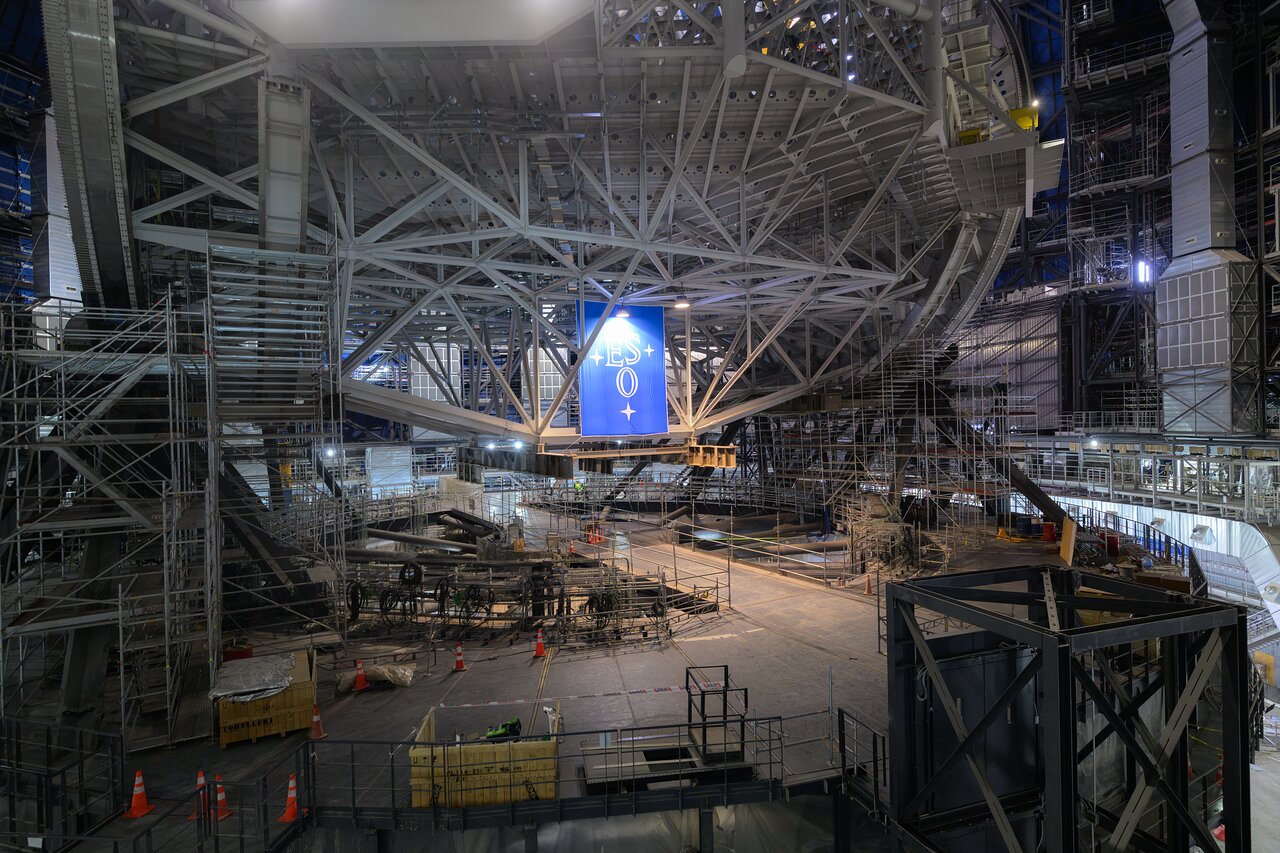
Inside the dome of ESO's Extremely Large Telescope under construction on Cerro Armazones in Chile
Observatories are engineering projects before they are science machines

Inside ESO's Extremely Large Telescope dome

StarStation is using real project photography wherever a facility can actually be photographed. Construction images, commissioning milestones, and official project sources are kept separate from future capability claims.

Photo: ESO/A. Russell · CC BY 4.0

ESO image source ↗
ESO ELT

Extremely Large Telescope

Under construction
Cerro Armazones · Chile

128-foot optical / near-infrared telescope with a five-mirror adaptive-optics design.

Current milestone

In 2026, ESO reported the main telescope structure had rotated for the first time. Telescope first light remains targeted for March 2029, with scientific first light planned for December 2030.

Why it matters

Exoplanets, black holes, distant galaxies, stellar populations, and fundamental cosmology.

Rubin / LSST

Vera C. Rubin Observatory

Survey underway
Cerro Pachón · Chile

Wide-field optical survey observatory using the 3.2-gigapixel LSST Camera.

Current milestone

The 10-year Legacy Survey of Space and Time began in late June 2026.

Why it matters

Dark matter and dark energy, Solar System inventory, the changing sky, and the Milky Way.

SKA Observatory

Square Kilometre Array

Under construction
Australia + South Africa

Two giant radio-telescope systems: SKA-Low in Western Australia and SKA-Mid in South Africa.

Current milestone

SKAO currently expects major construction completion in 2029 for SKA-Low and 2031 for SKA-Mid.

Why it matters

Cosmic magnetism, pulsars, hydrogen across cosmic time, galaxy evolution, and precision radio astronomy.

Giant Magellan

Giant Magellan Telescope

Under construction
Las Campanas Observatory · Chile

Extremely large optical / infrared telescope built around seven giant primary-mirror segments.

Current milestone

Construction and major procurement work remain active in 2026.

Why it matters

Exoplanets, galaxy evolution, black holes, stellar physics, and high-resolution spectroscopy.

Four facilities · four different jobs

There is no single “next Hubble.”

These projects complement one another. Rubin repeatedly surveys enormous areas of the optical sky. ELT and Giant Magellan pursue extreme sensitivity and angular resolution on selected targets. SKA listens to the radio Universe with vast distributed arrays.

Wide + fast

Rubin Observatory

Repeatedly scans the southern sky to catch change: supernovae, asteroids, variable stars, and other transient events.

Sharp + deep

ELT + Giant Magellan

Huge mirrors and advanced adaptive optics push ground-based imaging and spectroscopy to much finer detail.

Radio Universe

SKA Observatory

Thousands of antennas and dishes work together as interferometers, opening a different wavelength regime than optical telescopes.

What StarStation will track

Construction is only the beginning.

01

Construction milestones

Dome, structure, mirrors, antennas, camera systems, and major integration work.

02

Commissioning

Engineering tests that prove the observatory can operate as a complete scientific system.

03

First light + first science

The first images, spectra, or interferometric results that demonstrate real observing capability.

04

Operations

Survey starts, science cycles, instrument additions, and major data releases.

05

Discoveries

The astronomy that matters after the engineering headlines are over.

Source policy

Schedules are targets, not promises.

StarStation uses official observatory and project sources for status and schedule language. Construction dates can move, so this hub avoids invented countdowns and distinguishes active operations from commissioning and future capability.