
Primary mirror
128 ft
A segmented primary with 798 hexagonal mirror segments.
ESO’s ELT is a 128-foot optical and near-infrared observatory under construction on Cerro Armazones in Chile. StarStation tracks the engineering, instruments, science goals, and the road to technical first light.
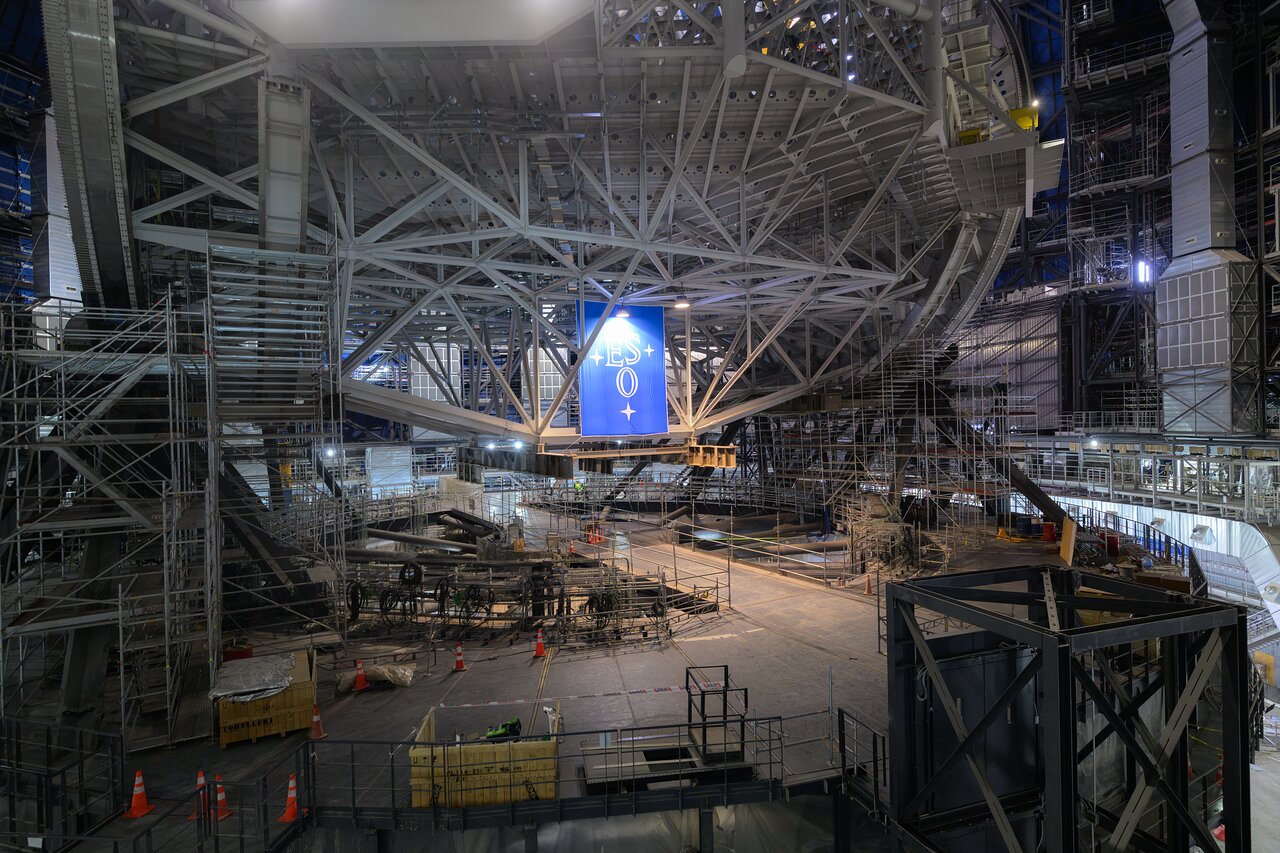
The 2029 date is ESO’s planned year for telescope test observations. ESO targets telescope first light in March 2029 and scientific first light in December 2030. Both dates are provisional; see the official ESO timeline below.
A segmented primary with 798 hexagonal mirror segments.
ESO’s published collecting area for the ELT primary system.
A five-mirror system with adaptive optics built into the telescope architecture.
High in Chile’s Atacama Desert, near ESO’s Paranal Observatory.
ESO's current ELT timeline separates construction milestones from telescope first light and later scientific operations. These are planned dates, not guaranteed deadlines.
In an ESO image release dated 27 April 2026, the ELT was described as more than 70% complete. That figure is a dated construction snapshot, not a live progress meter. In July 2026, ESO documented the first rotation of the 7.7-million-pound telescope structure, a major test of its ability to point across the southern sky. These engineering tests do not mean the telescope has reached first light.
ESO lists completion of the 13.9-foot secondary mirror, the largest convex mirror made for a telescope, as a 2026 project milestone.
ESO plans completion of the dome, main telescope structure, and 12.3-foot tertiary mirror.
Installation of all 798 primary-mirror segments is planned to finish, alongside completion milestones for the adaptive M4 unit and fast tip-tilt M5 mirror.
ESO plans telescope first light after initial test observations and major system integration.
ESO expects the first observations delivered with scientific instruments after installation and commissioning.
The ELT does more than collect a huge amount of light. Its optical train actively corrects and stabilizes that light before it reaches the science instruments.
128-foot segmented primary mirror. It gathers the incoming light and sends it toward M2.
A giant convex secondary mirror redirects the light toward the tertiary mirror.
The tertiary mirror relays the beam toward the adaptive-optics mirrors.
A deformable mirror changes shape rapidly to correct atmospheric turbulence and residual optical errors.
A fast tip-tilt mirror stabilizes the image before the light reaches the instruments.
Once the ELT’s optics collect and correct the light, its instruments turn that light into images and spectra. ESO's first-generation suite is HARMONI, MICADO, MORFEO, and METIS. ANDES and MOSAIC are planned to begin operations later.
Visible and near-infrared integral-field spectroscopy for distant galaxies, stars, black holes, and exoplanets.
A near-infrared camera designed for extremely sharp and deep imaging.
A multiconjugate adaptive-optics system that will help MICADO achieve exceptional image quality.
A high-contrast infrared imager and spectrograph for planets, disks, stars, and distant objects.
A later-stage high-resolution spectrograph aimed at extremely sensitive measurements.
A later-stage instrument designed to measure many stars and galaxies efficiently.
ESO lists direct imaging and atmospheric characterization of exoplanets, including worlds in habitable zones, among the ELT’s highest science priorities.
The ELT is designed to study the Milky Way’s central black hole and black holes in other galaxies with unprecedented detail.
Its collecting power and angular resolution will let astronomers study distant galaxies and their internal structure across cosmic time.
ESO includes dark matter, dark energy, stellar evolution, and other fundamental questions in the ELT science case.
StarStation will treat ELT development like an observatory mission timeline: major structure milestones, mirror progress, instrument integration, commissioning, and eventually first-light results.
Track major construction and enclosure milestones on Cerro Armazones.
Watch segment production, coating, installation, alignment, and active-control progress.
Follow M4/M5 integration and the systems required to correct atmospheric turbulence.
Watch HARMONI, MICADO, MORFEO, and METIS move from integration toward commissioning.
ESO targets March 2029 for initial telescope test observations, before instrument commissioning.
ESO targets scientific first light in December 2030, followed by verification that the instruments deliver their intended performance.
Engineering figures, instrument status, and schedule language on this page are based on ESO’s ELT project materials. StarStation will not convert a target year into a fake exact countdown or imply that future instruments are already operational.