NASA’s NEO Surveyor Sunshade Passes Ground Tests Ahead of Asteroid-Hunting Mission
Engineers have completed ground checks of NEO Surveyor's 20-foot sunshade and 864 solar cells. The asteroid-hunting telescope has not launched, and further spacecraft testing remains.
The story in plain English
Engineers have completed ground checks of NEO Surveyor's 20-foot sunshade and 864 solar cells. The asteroid-hunting telescope has not launched, and further spacecraft testing remains.
October 27, 2026 | NASA’s next dedicated asteroid-hunting space telescope has reached another construction milestone. Engineers have integrated solar cells into the sunshade of NEO Surveyor and completed a series of ground checks, NASA reported October 26.
The 20-foot-tall structure is designed to do two jobs: shield the infrared telescope from sunlight and generate power for the spacecraft. Its base measures about 8 feet across. NASA says the two panels meet at a 23.5-degree angle and carry 864 interconnected solar cells, capable of producing up to 2 kilowatts of power.
Why the sunshade matters
NEO Surveyor will look for asteroids and comets by detecting heat they emit after sunlight warms them. That makes infrared observations useful for finding dark objects that reflect little visible light. Its 20-inch-wide infrared telescope is designed to survey regions that are difficult for ground-based observatories, including areas of sky closer to the Sun’s glare.
Keeping direct sunlight away from the optics helps preserve the temperature conditions infrared observations require. The sunshade is therefore not merely a cover: it supports both the telescope’s cooling and the spacecraft’s electricity supply.
What has actually been completed
NASA reports that the solar cells were installed earlier this year. The assembly underwent thermal-vacuum environmental testing in March, was delivered to BAE Systems in Boulder, Colorado, in May, and was inspected there in July. The October 26 update reports further sensor integration and functional testing.
These are ground engineering milestones, not observations of asteroids and not proof that the whole spacecraft is ready to fly. Additional integration and mission-level checks remain. NASA’s current mission page lists launch no earlier than September 2027, a target rather than a confirmed liftoff time.
What scientists hope to learn
The mission will use two infrared bands to estimate the temperatures and sizes of near-Earth objects. Better measurements of asteroid location, motion and size can improve planetary-defense assessments. The project does not imply an asteroid impact is imminent or that a new threat has just been discovered.
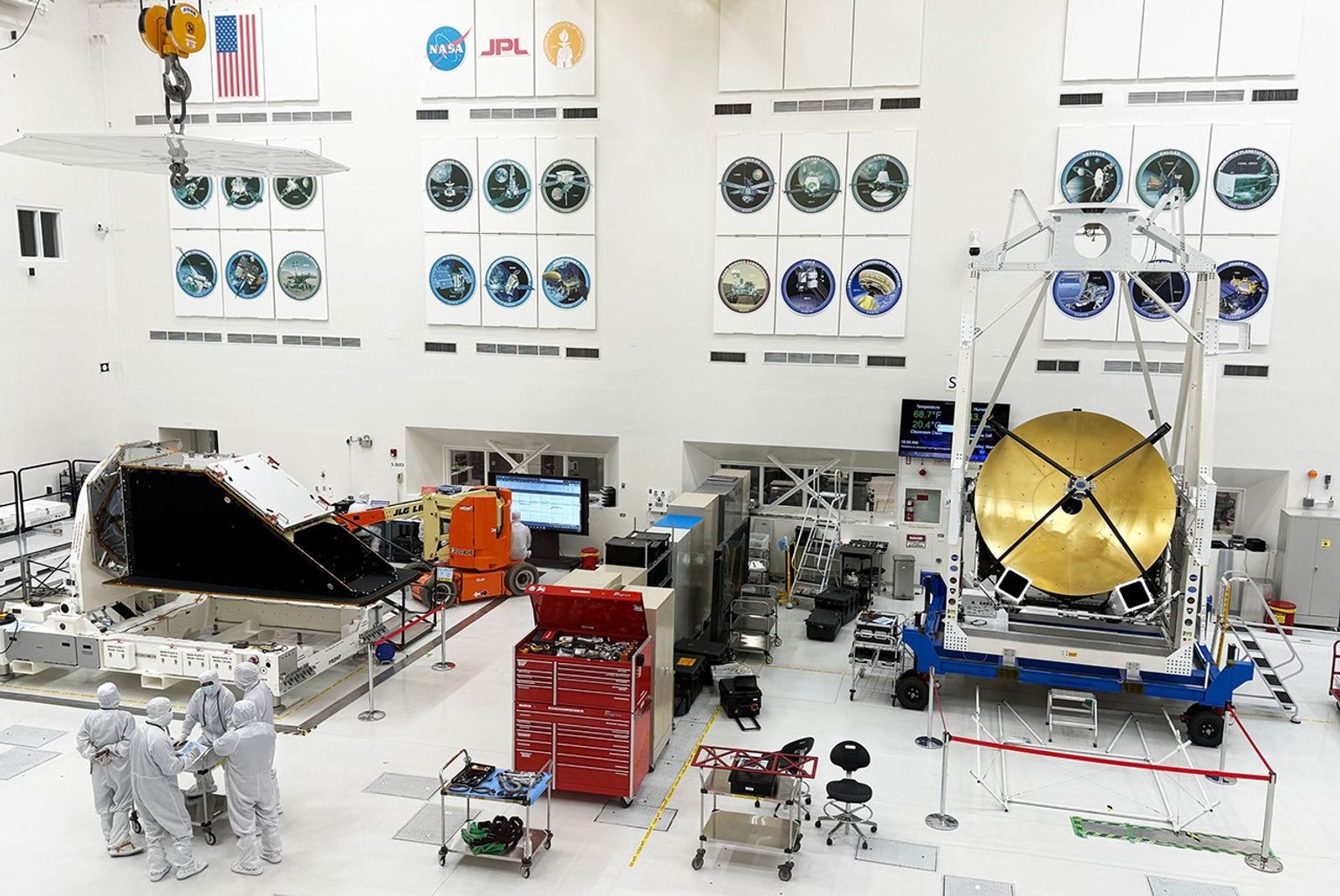
Primary sources: NASA engineering update, October 26, 2026; NASA NEO Surveyor mission status. The featured photograph is a NASA/JPL-Caltech archive image (PIA26584) of NEO Surveyor’s instrument enclosure inside JPL in March 2025. It does not depict the 2026 sunshade tests. NASA credits the October story’s sunshade-inspection photographs to BAE Systems Space & Mission Systems; those separate contractor images have not been reproduced here.
Primary source: NASA Science ↗
Research paper: Open paper ↗