Perseverance Finds Ultrafine Mars Dust Clinging to Spacesuit Materials
NASA's Mars rover measured dust on spacesuit-material samples, including particles far smaller than a human hair. The findings may help engineers protect future crews, but they are not direct measurements of astronaut exposure.
The story in plain English
NASA's Mars rover measured dust on spacesuit-material samples, including particles far smaller than a human hair. The findings may help engineers protect future crews, but they are not direct measurements of astronaut exposure.
October 27, 2026 | A set of small material samples riding on NASA’s Perseverance rover has become an unexpected test of one of the biggest challenges facing future Mars crews: keeping fine dust out of spacesuits and living spaces.
In a report released October 26, NASA’s Jet Propulsion Laboratory described measurements of dust that accumulated on calibration targets carried by the rover. The analysis spans 1,645 Martian days and includes particles much smaller than those measured in earlier studies on Mars. The peer-reviewed research was published in the Proceedings of the National Academy of Sciences on October 27. StarStation checked both NASA’s report and the published research. Particle sizes were estimated from X-ray measurements and modeling, rather than from direct microscopic images of each grain.
What the rover actually measured
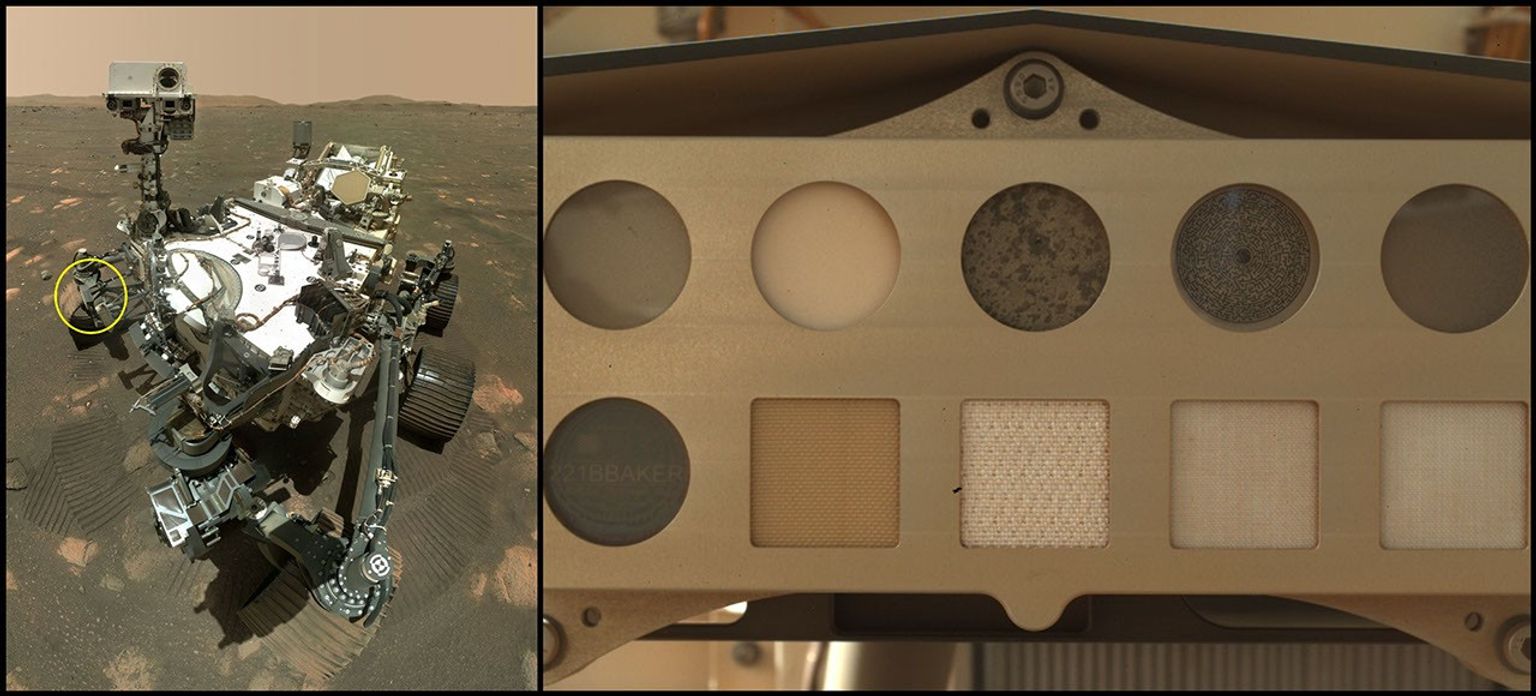
Perseverance carries samples of materials used in spacesuits, including Teflon and Vectran, on calibration targets for its instruments. The PIXL X-ray instrument measured dust on those targets. Some grains were less than 2.5 micrometers wide; others measured roughly 100 to 300 nanometers. A human hair is about 70 micrometers across, so these particles are exceptionally small.
The smallest grains appeared to remain attached despite the rover’s long journey across rocky terrain. NASA’s researchers say electrical charging may help explain why different materials collect different particle sizes. That is a plausible interpretation of the observations, not a demonstration that every future suit will behave the same way.
Why it matters for people
Fine dust is a concern because particles small enough to reach deep into human lungs can be difficult to keep out of equipment and enclosed spaces. Mars dust also contains reactive minerals and chemicals. But Perseverance did not measure dust inside an astronaut’s lungs, prove a particular illness, or test a finished crew habitat. Those health and engineering questions still require further work.
Possible responses include improved material choices, dust-resistant coatings, suitports that keep dusty suits outside habitats, and better airlock procedures. This study gives designers measurements from the actual Martian environment rather than relying entirely on laboratory simulations.
What comes next
Researchers can compare how dust sticks to different materials and refine procedures for future missions. The measurements do not establish a timetable for a crewed Mars landing, and they should not be confused with evidence for life on Mars.
Primary reporting: NASA Jet Propulsion Laboratory, October 26, 2026; NASA mission release; peer-reviewed study in PNAS, October 26, 2026. Image credit: NASA/JPL-Caltech/MSSS. The featured image is an authentic, annotated NASA composite showing Perseverance and its SHERLOC spacesuit-material calibration target, not a microscopic image of the dust grains. Original NASA photojournal record (PIA26520).
Primary source: NASA Jet Propulsion Laboratory ↗
Research paper: Open paper ↗